This is a partial and rough English version of my blog Just Indie Comics (Banner by Pat Aulisio)

domenica 13 ottobre 2013

Optic Nerve #13, We Will Remain, Alamo Value Plus #1


I was trying to organize some comics read recently and I picked up three of them for a review, starting with Optic Nerve #13 by Adrian Tomine, released in July from Drawn & Quarterly. I liked a couple of years ago Tomine's decision to resume publishing his series in the classic comic book format, while all his renowned colleagues dedicated themselves to graphic novels or converted their ongoing series in books (just like Chris Ware and Seth respectively with Acme Novelty Library and Palookaville). Issue 12 of Optic Nerve in September 2011 brought a breath of fresh air, especially with the first tale, A Brief History of the Art Form Known as "Hortisculpture", in which Tomine did something new compared to the past, regarding form, tone and content. Unfortunately this new issue is a step backwards, since that - always in my humble opinion - the main tale Go Owls is not perfectly successful. Go Owls combines the author's typical themes - remembering especially the issues from 5 to 11 of Optic Nerve (collected in the paperbacks Summer Blonde and Shortcomings) - with the ironic feeling of Hortisculpture, though creating a not so exciting mix that after a two-years wait leaves a little disappointed. Even the story published as the comic book cover isn't so funny as it should be. So it's better to immerse yourselves in the eight beautiful full color pages of Translated, from the Japanese, where Tomine tells in epistolary form the journey of a mother and her child from Japan to the United States during a family crisis. Deep, melancholy, introspective, the story doesn't show the characters but only the places where they move: someone can even consider it an exercise in style, but for me this is pure early days Tomine with the drawings and the elegant colors of today.


From Brooklyn, where Tomine lives at the moment, we move to Providence to meet Andrew White, a 22 year-old cartoonist who published for Box Brown's Retrofit Comics We Will Remain, a 48 pages collection of short stories subtly interconnected. This is a partly immature work, but even in the alternation of styles and techniques and with some indecisions in describing the human figure, White shows to have good ideas and can be considered a promise. What I like about him is the ability to look beyond the realism of the stories. So he gives a mysterious and magical tone to As Leaves Change Color, puts the metaphysical in the "title track" and shows some Kirbesque influences in Travel, a notable sci-fi experiment. If he succeeds in creating the right mix of intimacy and less usual themes, he will do great things.


Different spirit for the first issue of Alamo Value Plus, new series published by the excellent Revival House Press and created by Rusty Jordan, who already realized for the same imprint Buger Warz (with Levon Jihanian). Jordan's cartoon style is already perfectly mature and is used in a way that looks at the tradition of underground comics as to Peter Bagge. The first pages show a long dialogue between the protagonist Baldo and his colleagues at the department store where he works. But you have to wait just eight pages to get a crazy flashback taking up the rest of the book, where Baldo tells in an excessively epic and totally unrealistic way his struggle against Nazis during childhood, his and his mother's imprisonment and finally theirs escape. The last part of the story comes back to the present and portends a showdown between the main character and his nemesis, Captain Max Schidthed, still alive and longing for revenge. Alamo Value Plus is an enjoyable read that promises bizarre developments.


lunedì 23 settembre 2013

š! #13-14

Various Authors, Kuš! Komiksi, Riga (Latvia), April and August 2013, 164 pages and $13 (worldwide shipping included) each.


With the publication in late August of the new Kuš comics anthology, we can also look back at the previous issue, out last April. Founded in November 2008, the Latvian magazine has earned a remarkable reputation in the international comics scene, so that the editors are now able to create a good mix between emerging authors and indie cartoonists already known to the audience. Every book has a general theme and is characterized by a style that if isn't typical of all the names involved, at least associates most of them. The heterogeneous proposals are in fact dominated by a strong graphic impact, in which the form prevails and the content tends mostly to divertissement. Since it's very difficult to examine all the 328 pages of the two volumes, I prefer to talk briefly about the contributions I found the most original and accomplished.
The issue 13, entitled Life is Live, contains "autobiographical, semi- autobiographical or even autobiografictional comics" due to artists who usually do not deal with realistic and biographical themes. The decision to choose an Ana Albero cover fits perfectly, since she is one of the members of German collective Biografiktion (I reviewed their book published by Nobrow Press a few posts ago). She also realizes the interior illustrations and a short story in black and white, simple in the structure but pleasant for the grace used by the Spanish cartoonist living in Berlin to draw the rotund female figures. Other special guests are Simon Hanselmann, from Australia, author of a new chapter of his funny series Megg, Mogg and Howl about a poor owl mistreated by a cat and a witch (pay attention to the collection Megahex, to be released next year by Fantagraphics), and the Puerto Rican Jonny Negron, with his elongated heads, the innovative construction of the page and the hallucinatory atmosphere. Among others, I liked Anete Melece light but graphically well-done story, Dogboy who proves to have a personal style with his morbid and strongly colored cybersex tale, and Ruta Briede, able to focus on an idea and develop it in a pop-art solution.


Issue 14 is dedicated to sports and has an Amanda Baeza cover. The Chilean girl is also author of Ping Pong Studies, in green and orange with the page splitted like a ping-pong table and the figures who come out from the panels expressing their dynamism. Dutch Michiel Budel, known for Wayward Girls series published overseas by Secret Acres, wins the award of the coolest guest: Roller Derby with the Warriors is a story of ruthless skaters characterized by slender figures and pastel colors, where gratuitous violence and humour go hand in hand.


Latvian artist Dace Sietina does a good work too. Already a contributor in the previous š!, she improved her style, hitting the target thanks to elaborate splash pages focused on mexican lucha libre. It's impossible then to describe sports without references to the world of anime. In Taken Hong Kong cartoonist Lai Tat Tat Wing mixes exasperated sports and science fiction in the typical Japanese tradition, while Team Spirit of Italian artist Ratigher, manga from style to subject, tells of a newcomer in a synchronized swimming team harassed by demonic mates.


For other informations you can check Kuš! website, where you can discover the artists involved, or better yet you can order the magazine, sold at a very honest price, thanks to the small size (A6) and the praiseworthy support of the Latvian State Culture Capital Foundation.

domenica 25 agosto 2013

Lose #5

Michael DeForge, Koyama Press, Toronto (Canada), June 2013, 48 pag., $8 Cdn.

Michael DeForge is unleashed. Canadian Koyama Press issued in May his new book, Very Casual. Drawn & Quarterly will publish a collection of his strip Ant Colony early next year. Despite his editorial achievements, he is still creating on-line comics and will start in these days a new one, Leather Space World, inspired by the short story published in the seventh issue of londinian anthology Nobrow. If you think he also was the curator of Youth in Decline erotic comics anthology, Thickness, you can consider him an artist in creative trance.
The fifth issue of the one-man anthology Lose is largely filled by Living Outdoors, a triangle of juvenile love against the backdrop of a psychedelic nature, which enhances the sensations and the sexual urges of the characters. The apparently light plot hides an obsessive Bildungsroman with a dramatic finale. 
Recent Hires and Muskoka are equally good. In the first we are acquainted to a paranoid and self-defeating protagonist, while in the second a trip to the desert in search of luck ends with a terrible series of murders. 
DeForge describes an irrational and insane world but he gives perfect sense to it, thanks to a highly personal style, able to transcend genres. And he does this with a wry smile towards the characters and the events.
If you still haven't read the issues from 2 to 5 of Lose, you may be happy to know they will be collected in the book A Body Beneath, to be released next spring.

martedì 6 agosto 2013

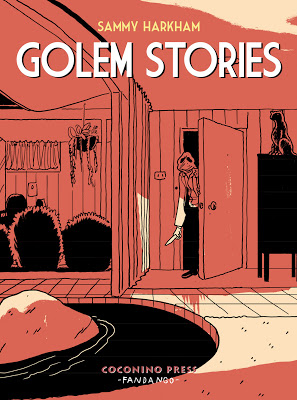
Golem Stories


Sammy Harkham, Coconino Press, Bologna (Italy), June 2013, paperback, 128 pages, 19 euro.

Italian version, with bonus features, of 2011 PictureBox anthology Everything Together. Harkham, 33 year old, is one of the most influential artists in the North-American indie comics scene, as an author and as Kramers Ergot editor. He is also the owner of Family, a Los Angeles bookstore. One of the best comics in the book is Poor Sailor, already published in Italy by Coconino on the seventh issue of the anthology Black. Originally seen on Kramers 4, the story is characterized by sparse dialogue and a graphic style à la Popeye, on which Harkham puts explosions of realism and violence. The revision of the tradition is typical of Harkham, as evidenced by the constant references to Jewish culture. His tales are linear but proceed always with ellipses, without being didactical.
Another important comic in the book is Somersaulting, here in a different version from the one published in Drawn & Quarterly Showcase 3. Harkham leaves the 9 panels per page of the Showcase version and chooses a 4 panel scheme that brings breath and wideness in the story of two girls in the 90s Australia, a kind of rural Ghost World.
Also noteworthy are the jewish tale Lubavitch Ucraina 1876, the exploitation-surrealist pastiche Nightmare and The New Yorker Story, four pages full of panels (up to 25 per page) in white, black and blue, in which Harkham sketches the figure of a wannabe-writer, adulterer and envious academic.
Golem Stories is an ironic, deep and smart book, both humble and ambitious, the work of a young and multi-talented artist, who is already one of the greatest cartoonists of our time.