This is a partial and rough English version of my blog Just Indie Comics (Banner by Pat Aulisio)

lunedì 28 luglio 2014

Zombre #1-2 + Magic Forest #1 + Zombre #3 Preview


The first issue of Ansis Purins' Zombre was a 12-page mini-comic in black and white, almost completely silent and in which the author told the clash between the protagonist, a zombie who lives in a magical forest located on an island, and Slappy, a negative version of the same Zombre. In addition to this Megathunder Showdown between the two, the book served to introduce the characters of the series, including Ranger Elvis and Ranger Jones, the first a vegetarian and messy hippie, the second his tyrannical and obnoxious boss hiding an unexpected secret.
It's in Zombre #2, titled The Magic Forest and winner of a Xeric Foundation Award, that these characters take a clearer form, allowing us to appreciate the art of Purins after a debut that looked more like a divertissement. The second issue - published in 2010 in a larger format and 48 pages - is characterized by a remarkable stylistic change. The small and detailed panels of the first issue, dominated by gray backgrounds and a marked line, give way to airy pages, where the prevalence of the white highlights a clear and well-defined line. Since the first pages of the book the author enjoys drawing his characters, the animals of the forest, the trees and the waterfalls, lining up bucolic and elegant pages with no text. The plot is built on a visitor of the island and her daughter, forced by the father to wear a helmet to protect herself from the "dangers" of nature.


Their encounter with Zombre is a succession of funny visual gags, although the entertainment is mostly due to Ranger Martin Elvis, clumsy and always late, certainly a memorable character. While he was working on Zombre #3, Purins published last year Magic Forest #1, a sort of Zombre #2.5. In these 16 pages, some in color, the author omits the landscapes in favor of one-off gags where Zombre doesn't appear, leaving room for funny situations starring the rangers and also sirens, elves, fairies and spiders. 
The main plot will continue in the long awaited Zombre #3, an 80-page full color episode currently in the works. In the meantime I was sent a preview and I liked how the story develops in line with what we have seen so far, adding new revelations about the characters and their origins, with some twists that spice up the narration. The new issue is in my opinion the best one, representing a new evolution in the cartooning of an artist with an exquisite line and able to create his own fictional universe.


A page from Zombre #3

lunedì 21 luglio 2014

Short and Merciless Stories

Marco Taddei & Simone Angelini, Tinto Press, August/September 2014, 112 pages, black and white, perfect bound, 6.69" x 9.45", $ 13.


I reviewed the Italian version of this book some months ago. It was published by Bel Ami Edizioni last October under the title of Altre storie brevi e senza pietà and now will have an American edition due in August or September thanks to Ted Intorcio of Tinto Press. I took a look at the pdf of the English-language version, so this is both a translation (with some changes) of my Italian review and a preview of the new book.
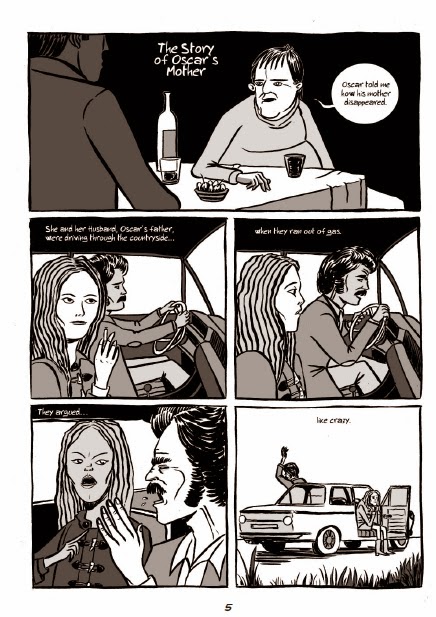
The two authors are well-known in the Italian indie scene: the writer Marco Taddei is also a novelist, photographer and editor of Stra magazine, while the artist Simone Angelini is the creator of a "comic book fight club" called Canale delle Mazzate and of the Pics Festival in Pescara. They published a collection of comics of the same kind previously, but it's with this one that they found their own personal style. Inside there are eight short stories about themes such as death, human misery, madness, alienation, existential vacuum and sometimes also social networks and politics. They often seem urban legends, unsolved crime news, tales heard in a bar but at the same time they speak about all of us. Usually there is someone relating these tales, a voiceover that gives regularity and also gravity to the narration. This is reflected in the structure of the page: every comic uses a fixed number of panels, breaking the order only to mark key moments in the plot. So The Story of Oscar's Mother is about a baffling disappearance, The Story of the Uncle is a metaphor about insanity that raises existential questions, The Story of a Fly shows an insect becoming a star on Facebook and dreaming a bright future, The Story of Mario in Hell describes an afterworld very similar to everyday life, The Story with Death ends the book reminding that nothing makes any sense at all.


Taddei's storytelling blends a lot of different things together and reaches the best results while using surreal elements and nihilistic humor. Otherwise - when the themes are political or social - he tends to moralize a bit much, as the story has to convey an explicit message. Much better is when he jeers at social conventions, watching the characters with a mix of sneering derision and sympathy. Angelini's drawings are essential and serve the story well, but they also have some remarkable visionary moments, as in the horrible corpse rendered in The Story of a Fly or in the final sequence of The Story of Mario in Hell, where a three-headed monster eats a whole line of unlucky men.
While Short and Merciless Story is coming out in the USA, the two authors are working on Anubi, a new project they're developing in a Tumblr page and which will become a book in a near future.


giovedì 17 luglio 2014

Abyssal Yawn - Part One

Ed Steck and Bill Wehmann, Pacific Reverb Society, Pittsburgh (USA), 2014, 32 pages, full color, $ 8.


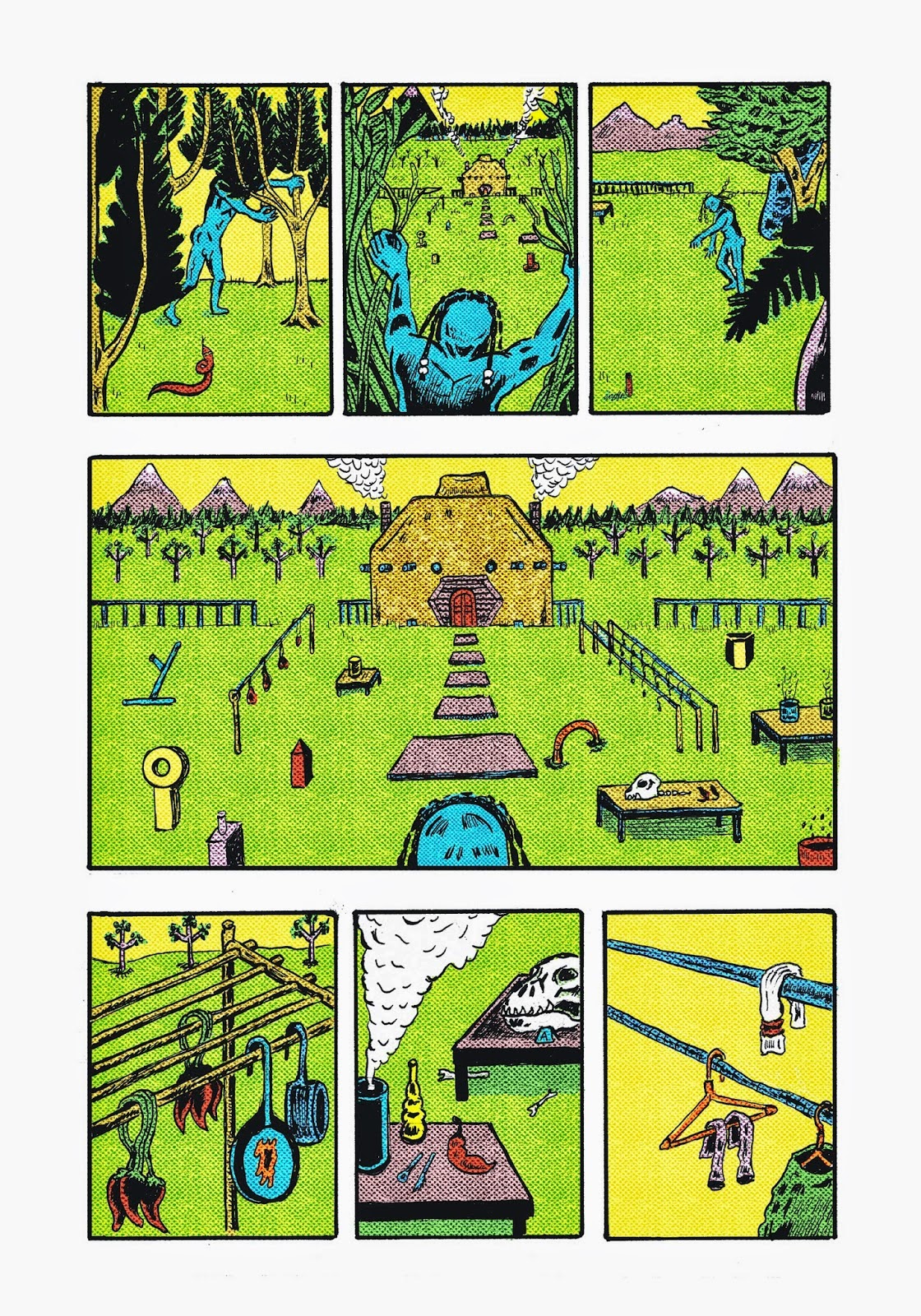
Bill Wehmann is the author of mini-comics as Death of Spot and Would You Still Love Me in Black and White and has recently begun a collaboration with the writer and poet Ed Steck for the series Abyssal Yawn, published by Wehmann's Pacific Reverb Society in an elegant full color comic book with heavy card stock covers. The first issue introduces to a story that recalls the Sixties and Seventies Marvel cosmic sagas as Stan Lee's and John Buscema's Silver Surfer and Jim Starlin's Warlock, updating the contents and adding irony and sociopolitical metaphors. The main character is a nameless hero made of the same substance of the outer space, a sort of Silver Surfer 2.0, with rasta braids and without underwear. After being freed from the "imprisoned pocket of eternity" by a mysterious entity, he begins his trip through eternal time, "suffering the peril of the everyday wanderings of a celestial nomadic universal being". 


The narrative-heavy captions describe step by step the journey of the protagonist until he reaches a planet called Berkornrog, which in reality is nothing but the mental projection of Max, a two-legged dog who walks around hooded while smoking a pipe. Max informs him of an intergalactic conspiracy leaded by Mother Sky Corporation, a company that is jeopardizing the whole existence of life with illegal drilling operations, depriving the universe of the celestial milk, "a fluid that enriches the inter-connected channels between parallel timelines".
Max invites the main character, now renamed Birch Twig, to embrace his cause and submit him to an initiation rite that includes eating a stew of imprisoned planets and the brain of a sick animal. The ritual will break his blue shell, turning him into an orange creature, as it will happen to the same Max. The two will launch themselves in the outer space to find Moter Sky Corporation on the cry of "Metal bodies of purity ride on". 
The large use of captions and the long digressions take back to comics of other times, but here there is also an ironic and underground approach. The elaborate and weird plot has the strong point - more than in the sci-fi quotes and in the inner coherence - in the intentional accumulation of odd elements. The part set on Berkornrog is the most visionary and brings out the effective use of color and the raw and incisive line of Wehmann. The planet presents objects of our daily lives close to exotic and tribal ones, giving a feeling of family strangeness, in the classic Star Trek tradition. As in the previous Death of Spot, not surprisingly made ​​for the Comics Workbook Composition Competition of last year, the narrative skills of the Pittsburgh-based cartoonist are enhanced when he uses a well-defined grid of panels (six, nine or even sixteen). The splash-pages are also plain but effective, able to fascinate with a few elements. Metal Bodies of purity read on, give us the second issue!


domenica 13 luglio 2014

Under Dark Weird Fantasy Grounds #1

Various Artists, Hollow Press, Italy, March 2014, 96 pages, black and white, perfect bound, 29,5 x 21 cm, 18 euros.


It comes from Italy but it could come from anywhere in the world. Or maybe Under Dark Weird Fantasy Grounds - the new biannual anthology created and edited by Michele Nitri and published by his Hollow Press in only 700 copies - comes from hell or from the center of the earth, since the comics by Mat Brinkman, Miguel Angel Martin, Ratigher, Tetsunori Tawaraya and Paolo Massagli lead to unknown and terrible lands.
The prologue to this unusual reality is in the six pages by Mat Brinkman, the founding member of Fort Thunder artists' collective and author of Multiforce and Teratoid Heights. Brinkman is a sort of guest star here, since he isn't a prolific cartoonist at the moment. We saw his work last year in the Monster anthology published by Paul Lyons' Hidden Fortress Press and he's contributed to the fifth issue of Weird edited by Noel Freibert. In Cretin Keep On Creepin' Creek he uses a wordless approach to tell the adventures of an animated and monstrous arm tortured by some strange creatures in a basement. The drawings are visceral, apparently raw but with a remarkable visual complexity. The tale also has a greater sense of structure and an extraordinary dynamism compared to other Brinkman's comics: this time the cartoonist guides the eye of the reader, that isn't free to skip between different points of the page as in Multiforce. Brikman's art grows year after year and when small, dense panels make way for a wider view, it's a joy for the eye. As for all the comics in the book, this is a first part, with a follow-up due in the second issue of the anthology.


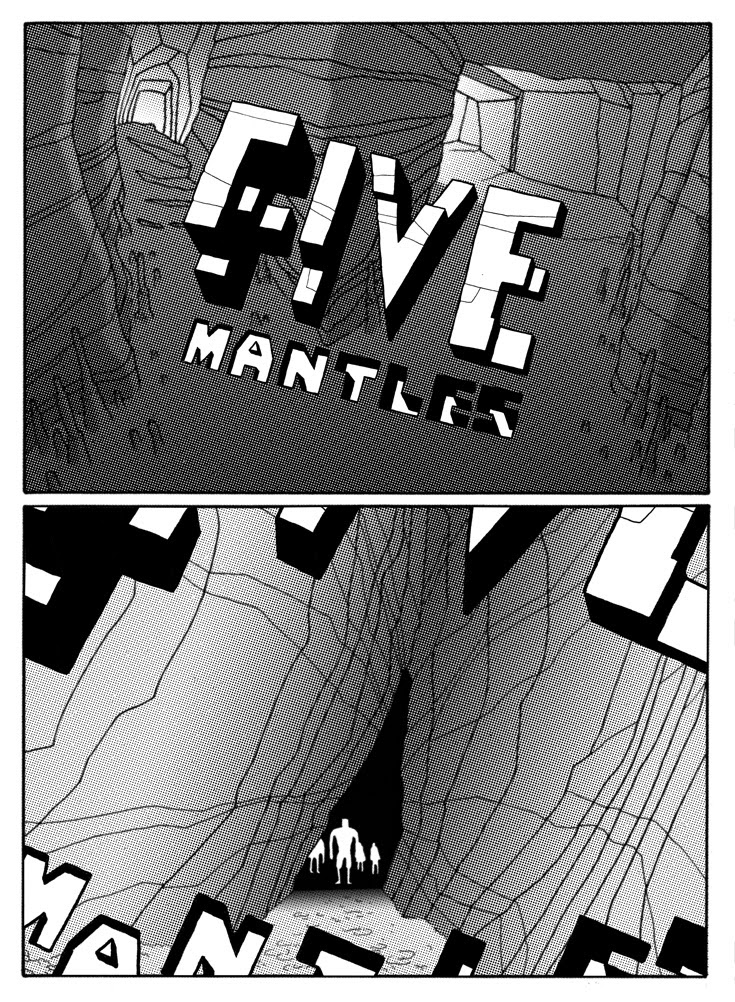
Miguel Angel Martin and Ratigher share the underground setting with Brinkman. These are two similar stories, in which the characters move in a sort of dungeon, akin to the setting of a role playing game. However, The Emanation Machine and Five Mantles are anything but classical fantasy tales. In the first, Martin's art and storytelling are at their best. A strange creature dies while giving a mysterious object to the two protagonists. It's the key for the emanation machine, "a subhuman fantasy". Actually the main theme, as usual in Martin, is sex: every action or event is a fantasy version of a sexual practice or perversion, creating a sense of claustrophobia present also in Ratigher's contribution. 


In Five Mantles the characters try to find an escape from an infinite series of tunnels. They can't remember why they're underground, but they have two magical mantles that can help them literally to rise from the darkness. This is the piece with more text and a more structured plot. Ratigher's style is significantly influenced by manga, while the real Japanese author in the anthology, Tetsunori Tawaraya, looks more at the tradition of monster movies. In The High Bridge bizarre creatures fight in a marine environment without uttering a word. In most panels the backgrounds are empty and Tawaraya concentrates on the monsters, depicted with amazing skill.


A good thing about UDWFG is that all the comics share a feeling while each author has his own style. This is confirmed by Paolo Massagli, who ends the book with a free-form comic. Hell is a wild trip to the infernal lands, where the pages are filled up with the white skin of the female protagonist, a dead young girl in search of an earth, maybe to escape from hell or maybe to live again. As in Tawaraya's work the attention is all on the bodies and not on the background, but here the focus isn't on wings, horns and tentacles but on breasts, lips, eyes and long eyelashes, giving to the book a touch of sensuality that had been missing until this moment.
It's rare to close a comics anthology with a well-defined feeling. UDWFG, instead, leaves a sense of pain, mystery and wonder. And also the strong desire to read the second issue, due at the end of September.

venerdì 11 luglio 2014

Irene #4

Various Artists, Irene (distributed by Hic & Hoc), April 2014, perfect bound, 152 pages, black and white, A5, $ 15.


The new issue of Irene is a jam session among its editors with the participation of several special guests. Initially related to the Center for Cartoon Studies, the anthology is freeing itself from its origins and also in this fourth issue finds strenght in the heterogeneity of contributions, as well as in a high quality standard. Starting from the collaborations between dw, Dakota McFadzean and Andy Warner, it seems that Ten Minutes Break - published in the third issue (here the review) and created by the first two - built a modus operandi. Veronica and the Good Guys in "Ain't Pussy Footin!" shows Warner drawing the characters portrayed in the previous issue by the same dw, now author of the story, creating an inner continuity: Warner's line, usually curvy but also realistic, is now cartoony, following the rhythm of a hyper-violent rock concert, in one of the best works in the book.


The three crave to innovate, change, experiment, borrowing the style of the other, taking his peculiarities, as Generals and Gods (by McFadzean/dw) and A Dream (by Warner/McFadzean) confirm. The fact that dw - with the usual sketchy and experimental style - draws also Walk Like You Mean It, written by Power Paola, gives further homogeneity to an anthology well cohesive thanks also to the interstitial cartoons (this time the funny gags by Ben Juers) and to the connections between a lot of the stories. The same Generals and Gods shares with The Dark by Laura Terry the theme of a threatening entity, Black Boots by Jackie Roche chooses the presidential subject just like Zapruder 313 by Luke Howard, while Emi Gennis' Nyos has in common the desolate and post-catastrophe setting with Yellow Plastic by James Hindle. These are two of the best things in the anthology: the first is a quiet account of a dramatic historical fact, while Hindle builds an intense work of fiction, characterized by small panels, sharp-cornered drawings and a narration near to the tradition of the American short story.


Boats by the Lebanese Mazen Kerbaj and Access by Georgia Webber are also excellent. Kerbaj is a new Mid-eastern cartoonist after Barrack Rima published in the previous issue: he is able to play with the geometry of the medium but also to break its patterns with visionary portraits of sailors and sea creatures. Georgia Webber tries instead to represent her vocal injuries using the layout of the page and a truly remarkable style. In conclusion I'd like to mention the illustrations by Amy Lockhart, with a gallery of literally disarticulated naked women, and Carlista Martin, a young, talented and brilliant illustrator based in Washington who mixes Julie Doucet, underground art, Bible references and Mondo Hipster.


lunedì 7 luglio 2014

Comics People: E.A. Bethea


I discovered E.A. Bethea in Tusen Hjärtan Stark, a tabloid format anthology edited by Austin English and published by his Brooklyn-based Domino Books with the attempt to present the art of rarely-translated European artists alongside difficult and innovative works by American cartoonists. In this first issue I appreciated the comics by Warren Craghead and Joanna Hellgren, two cartoonists I already knew, but it was E.A. Bethea's contribution that impressed me most. Five of her seven pages are based on a fixed grid of four tiers, creating a layout between 11 and 13 panels. The contents are focused mostly on the writing, while the drawings are essential and sometimes they disappear completely. Some panels are filled only by a text so intense that the frames seem too narrow, as if the words wanted to come out from the borders and turn into stream of consciousness. And perhaps without boundaries the text would give life to pages and pages of ink. These comics with a traditional macrostructure are joined by two full page illustrations with an explanatory paragraph below. However the contents don't change, as Bethea's works are structured more as digressions than as conventional narrations and use the language and the rhythm of poetry. This poetic streak becomes passionate lyricism in Poydras St. Coffeewharf, a nocturnal tableau of life in a harbor, and Blue for Night, Amber for Dawn, a philosophical and far from ordinary memory of a lost love. In other tales E.A. Bethea chooses the tools of biography and crime stories, telling in a visceral and direct way the adventures of a prisoner, a prostitute, Blanche Barrow, Lee Harvey Oswald and Malcolm X. Sometimes it seems to read a poem, other times a portrait of a famous man, an article from a newspaper or a personal diary. And the best part is that all these registers - combined with a subtle but almost ubiquitous humor and with a predilection for sexual and morbid elements - are often in the same page, making Bethea's art a well-defined body of work.


After reading Tusen Hjärtan Stark, I looked for some infos about the author, but the about-me section of her website tells simply that she "is a New Orleans-born artist, writer, musician, and record collector who lives in Brooklyn". Recently she added a link to her Tumblr and a list of publications where her drawings and comics have appeared, including some issues of Josh Bayer's Suspect Device, the magazine Smoke Signal and above all her personal anthology Bethea's Illustrated, published by Sad Kimono Books in 2009. At this point I had to read the book, which features in 88 pages comics made since 1999, for the most part published in xeroxed zines, and confirms the general tone of the works in Tusen Hjärtan Stark, mixing history, crime stories, humorous full-page portraits, biographies, real or imaginary autobiography, sex, dreams, references to literature and to the French nouvelle vague.


The first tale in the book is Speakeasy, set in the days of Prohibition, confirming the author's fondness for hidden bars, taverns, dives, harbors, seen as places where everyone can be a different person and clandestine sex is consumed. Her comics have a Thirties feeling and bring us back to the Great Depression, fitting in the period between The Great Gatsby and the Beat Generation. However the most of them isn't focused on a single theme, since E.A. Bethea has the unique ability to create free-form pieces, starting in one way and veering off in a completely different direction. And it's also unique her skill to give a melancholy and sometimes romantic form to her usual prosaic situations, as in Shaky, Makeshift Bridges, a love story between a prostitute and his client that among pimps, drugs and joyrides ends in this way: "When you wanted to leave me, you riddled me with questions of which I could provide no answer: does water have taste? Green or blue? Knife or fork? I was at a loss. I wanted to say both, but knew I was wrong. Now my eyes are slits and I am riding down a long bridge over black water. You are my destination and you are either very far or very close. Tell me, which is it? Have I chosen the right bridge or will I wake up without you, thrashing through wild waters & wreckage?". The images, the rhythm and the assonances give strenght and evocative capacity to the text.


Sometimes the lyricism becomes a poetic manifesto, as in Art Brut, where the artist describes herself as a "non-professional", "psychotic", an "amateur graffiti-writer". But in her comics the technique isn't important as the urgency to express herself, giving vitality to the drawings. Bethea's line is also improving year after year, so if in Bed & Board and My Days at Sea - both dated 2000 and dominated by a white background - the drawings are naive and sketchy, pieces like the same Shaky, Makeshift Bridges, Parchman Farm and Uncorking are more refined and detailed. From an aesthetic point of view the best results are in some full page illustrations, as A Depraved Murderess Drowning Her Husband, drawn in a Nineteenth century style, and the visionary The Babushka Lady. And Smoking Between the Cars, a new page published recently on her website, presents an interesting use of ink, expanding the horizons of Bethea's art.


I started writing this profile months ago, after reading the Domino books anthology. In the meantime I read Bethea's Illustrated and I revised and rewrited this text a lot of times. I don't know if I managed to describe E.A. Bethea's art and how much I appreciate it. Scott Longo of Sonatina Books did definitely better in his Tusen Hjärtan Stark review. In these months I also spoke to the same Elizabeth (her first name) through email. She mentioned among her influences David Collier and Aline Kominsky Crumb, told me that before his premature death in 2011 Gerard Smith of TV On The Radio had the idea of publishing Bethea's Illustrated, that her background is poetic and that she never took drawing lessons. While I was writing these words, Elizabeth contributed with some illustrations to the literary magazine No Tokens, with works also by writers such as Rick Moody and George Saunders, and to Suspect Device #4, where she is alongside the best American underground cartoonists. And she is always working to her comics, which will be collected in a new anthology one day.

mercoledì 25 giugno 2014

Nowt/Aktion #4

Gabriel Corbera, Miedo Publicaciones, Spain, April 2014, 20 pages, black and white, 2,50 euros.


Printed in a hundred copies and already sold out, the fourth issue of Nowt/Aktion is a new effort by Gabriel Corbera, the Spanish cartoonist well-known for his web-comic Monday Sucide and for his books published in the United States by Space Face. With Miedo, the imprint founded with his girlfriend Eva Monleón, aka Misako Mimoko, Corbera creates a lot of self-published comics. In this series we witness the performer Nowt in some reckless actions as jumping, grasping the wings of a plane, hanging to chains, breaking a glass with a fist and so on, while images and objects typical of Corbera's art - cobwebs, destroyed buildings, desolate landscapes, shotguns, tigers and caves  - recur.
Beyond the author's undeniable ability to build his own narrative universe with perseverance and dedication, mixing references to contemporary art with manga influences, there is much more in these comics. The last pages are in fact dedicated to the clash between Nowt and The Sad Machine, a device which manages to wear down and then to give up even the inexhaustible Nowt thanks to its "supersonic moans". This is only one of the situations in which Corbera's characters have to deal with something bigger than themselves, be it a machine, a conspiracy or a villain. The Spanish author is good at conveying this sense of oppression, usually vague but that sometimes becomes clearer, acquiring a social and political dimension, as it happens for example in Heroisch, a one-page story published earlier this year in Mould Map #3.
If you still don't know Gabriel Corbera and you want to get familiar with him, you can take a look at his Tumblr and keep an eye on Miedo website and on that of Space Face, that will publish soon a 120-page book with one of the best titles of the year, Days Longer Than Long Pork Sausages.